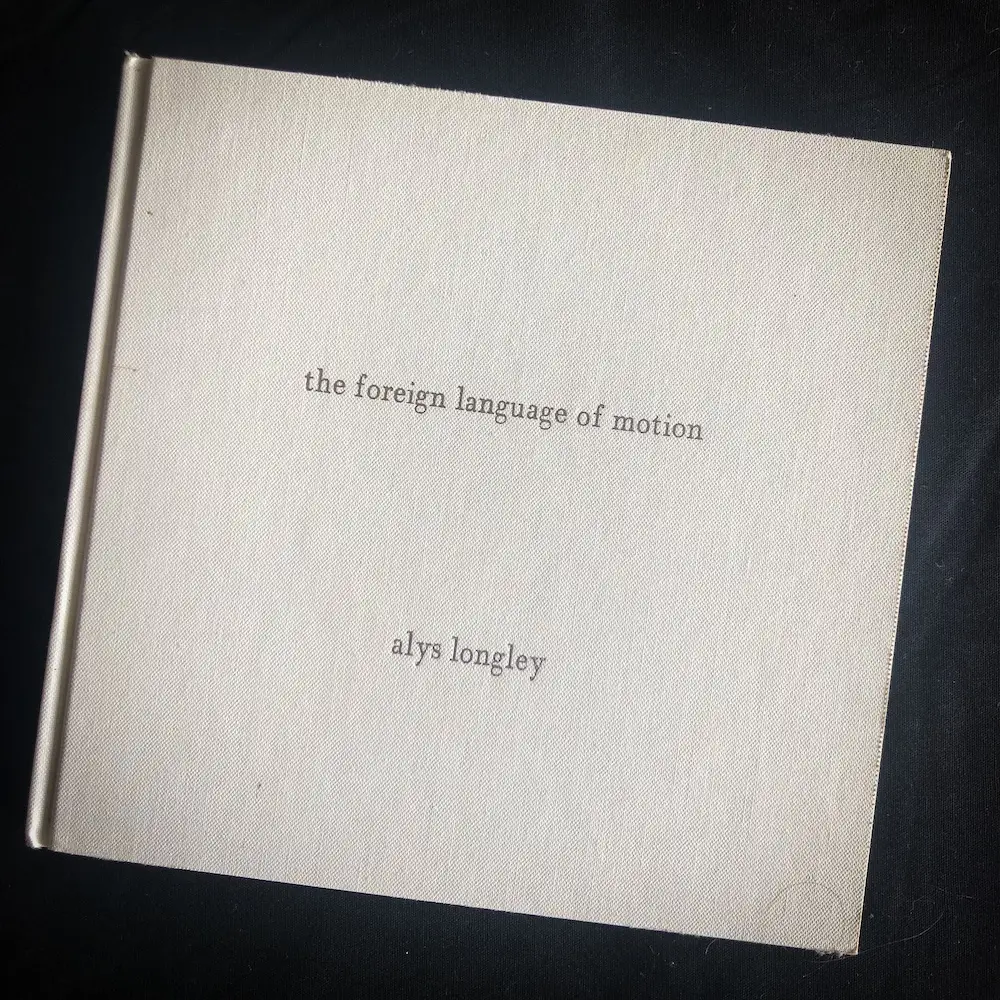
Book: by Alys Longley, published by The Winchester University Press, 2013 (Preface Series) · ISBN 978-1-906113-11-7
The Foreign Language of Motion is a two-part publication combining an extended piece of experimental performance writing — the kinesthetic archive book — with a self-reflective critical essay unpacking its methodology, in keeping with the Winchester University Press Preface Series format, which pairs a creative work with the author’s own commentary on its construction.
The kinesthetic archive book itself grew out of roughly 18 months of studio journals kept during dance practice, gathering writing generated directly from the sensorium of movement rather than written about it afterward. Pages of these journals were rephotographed, rescanned, rewritten, and reworked as surfaces for further drawing and writing, then assembled into the finished pages — described by longley as an experiment in documentation and translation rather than a representation, description, or substitute for the dancing itself.
The accompanying contextual essay situates the project within practice-led research, drawing on theorists including Susan Melrose, Brad Haseman, and Carol Brown to discuss dance as a distinct form of knowledge production — one that resists purely language- or spectator-based models of performance studies in favour of embodied, relational, and studio-based modes of inquiry. Longley frames the two parts of the book as designed to be read alongside one another: the archive book as the primary body of performance writing, the essay as a guide to the choreographic questions and provocations behind it.
The finished object is a carefully considered physical artefact in its own right: set in Bell MT, printed on 100% recycled Eco 100 paper, hand-bound in a half-binding by Clinton Goodwin at the University of Auckland bindery, with a screen-printed Winchester University Press logo on the back cover by Struan Hamilton of Elam School of Art.