Notas en la frontera, notas en el río, notas desde el océano
Te Atamira, Tāhuna/Queenstown — 27 September 2025 to 30 January 2026
A collaboration between alys longley, Máximo Corvalán-Pincheira, Francisco González Castro and Macarena Campbell-Parra
About the exhibition
Notes in the Border is a living, changing exhibition built from eight years of collaboration between four artists working across Aotearoa New Zealand and Chile. Rather than presenting a fixed body of finished work, the show unfolds over its months at Te Atamira — new pieces arriving, tables shifting from drawings into functional furniture, cards and scrolls accumulating — so that the exhibition itself becomes a record of an ongoing friendship as much as a set of artworks.
At its centre is a way of working the artists call artisfriendship: a term coined by longley and González Castro to describe how creative collaboration and personal friendship become inseparable over time. Exhibitions, books, performances, residencies and workshops are treated as punctuation marks in a relationship that continues regardless of whether a “finished” work results. That commitment to sitting in discomfort, mistranslation and not-quite-understanding, while staying open to listening, runs through everything in the show.
Sited between river, lake and mountain in Tāhuna/Queenstown — a place shaped by transient tourists, seasonal workers and a substantial Latin American migrant community — the exhibition treats migration as a fundamental and shared human and ecological story, not an exception to be managed at a border.
The artists and their work
Máximo Corvalán-Pincheira’s central contribution is Isla, a new floating greenhouse-raft built with the Queenstown community and launched on Lake Whakatipu. Carrying ferns and plants native to both Aotearoa and Rapa Nui — including kūmara, kōwhai and cabbage tree — the raft traces a symbolic triangle between Aotearoa, Rapa Nui and South America, echoing the extraordinary ocean voyages of Polynesian navigators over thousands of years. Recorded voice-over stories from island residents play inside the vessel as it moves across the water at dusk. Isla is the third chapter in a decade-long body of work in which the floating greenhouse operates as a metaphor for the migrant body — human or vegetal — protecting what is vital while in motion. Alongside it, his Topografías del Agua (Intervened Maps)whites out everything but waterways on nineteen local maps, turning rivers and lakes from borders into a living circulatory network.
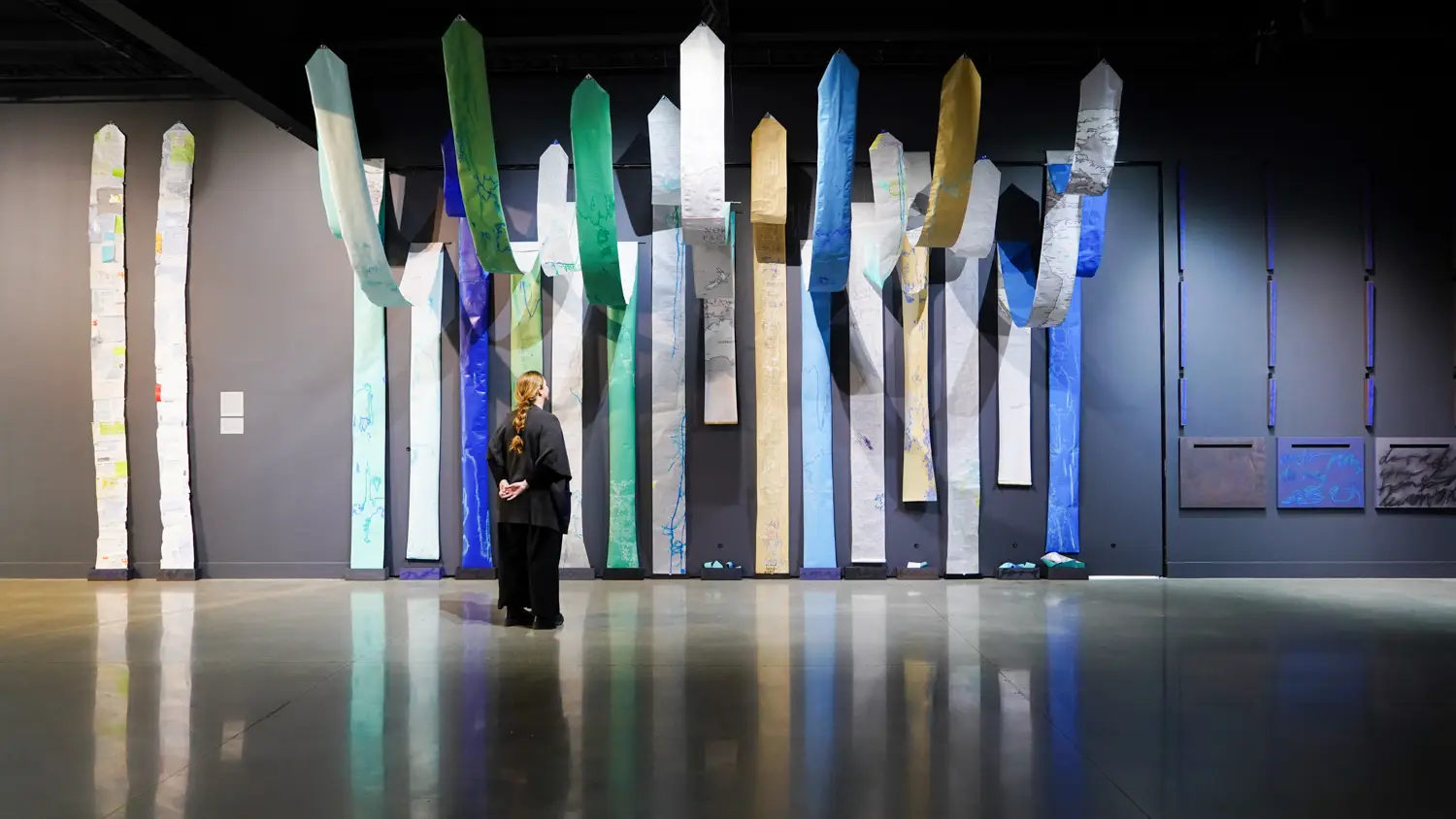
alys longley’s works include giant scroll-like drawings and pianola-roll-shaped pieces (Because life is formed by fracture), bilingual text works dissolving across the gallery’s windows (Because the Magnetism of Connection), and the Mistranslation Notes — scrolls made from envelopes recording years of daily language-learning attempts. Her card game and artwork Soft Borders Lifting pairs cyanotype prints with miniature blackboard surfaces, inviting visitors to erase, rewrite and improvise, treating language itself as a porous, moving border.
Francisco González Castro collaborates with longley on the artist book How can you go through me?, a folded, foldable stream-of-consciousness text questioning how cultural and cognitive bias might be rerouted, alongside a virtual, game-like exhibition site, A Tilting Body of Precarious Maps & Migrant Constellations, developed with NYC studio DotDot.
Macarena Campbell-Parra, with Rolando Jara, Eduardo Cerón-Tillería and collaborators as Colectivo Somos, presents documentation from the durational Proyecto Cartón (Cardboard Project) — a years-long inquiry into cardboard as body, migrant and listening tool, developed through workshops across Chile and a 2021 online residency with Swedish dance artist pavle heidler.
Themes
- Counter-mapping — treating maps not as neutral authority but as poetic, ethical, always-partial drawings of human and ecological relationship.
- Migration as human condition — set against a 2025 marked by hardening borders worldwide, the exhibition insists that movement across geography, culture and language is what has always shaped culture itself.
- Translation and mistranslation — language failure, bilingual overlap and the labour of learning a second language become material and method, not just subject matter.
- Touch, listening and friendship — drawing on Jean-Luc Nancy’s writing on touch and community, and on generous rather than extractive listening, as a shared ethic across the artists’ work.


On Friendship-Artworks: A Reflection on the Creative Process behind the exhibition Notes in the Border, Notes at the River, Notes from the Ocean
Alys Longley
“The friendship is more important than the work, always.” (Alys Longley and Francisco González Castro, Manifesto In Shambolic Form).
“Sometimes Doing Something Poetic Can Become Political/ Sometimes Doing something political can become poetic” (Francis Alÿs).
The exhibition notes in the border, notes in the river, notes from the ocean exists in a space of interconnection and exchange between Aotearoa, Chile and Latin America. It presents a project that transforms through its time in the gallery, reflecting artistic collaboration as something precarious and delicate, as is asking geopolitical questions across borders of ocean and language. This project recognizes a group of artists – myself (Alys Longley), visual artist Máximo Corvalán-Pincheira, visual artist Francisco González-Castro and dance and interdisciplinary artist Macarena Campbell-Parra – who have worked together over the last eight years with a focus on connections across language, creative exchange between Latin America and Aotearoa across the Pacific, and attention to geopolitical movement over time and across cultures. These collaborations have continued through the recent Chilean Estallido Social, virtually as the COVID 19 pandemic unsettled the world, and in exhibitions, residencies and performances in Santiago, NYC, Montreal and Mexico as travel allowed movement across the world post-pandemic. It is a pleasure for our group to continue this process of exchange and to bring some of this work back to Aotearoa with Tahuna/ Queenstown as our base.
Over the last eight years I have worked intensively with Macarena, Francisco and Máximo in a series of interconnected projects. I have consistently been drawn back to Santiago for the enriching opportunity to work in an artistic ecosystem very different to that of my hometown of Tāmaki Makaurau (Auckland). Relationships between art and politics are very lively and considered in Chile, and the urgency of creating work as part of an artistic community is keenly felt. We are collaborators for whom friendship and creative practice are interlinked – we’ve worked together in museums, dance studios, theatres, galleries, virtual art spaces, books and residencies. This interdependence – the friendship depending on the art projects, the art projects riding on the friendships – is a seam connecting the artists in this exhibition.
One influence on this exhibition is the work Proyecto Undular: Undular Project developed alongside with Francisco González Castro and Macarena Campbell-Parra in 2023-2024. Core to Proyecto Undular is the concept of artisfriendship – a term González Castro and I developed to recognize the blurring of friendship and artistic collaboration (softening the distance between these concepts by removing a ‘t’ in the centre of the word). Artisfriendship blurs the line between friendship and artistry, recognizing the care and commitment to time spent listening and exchanging ideas as valuable in itself, regardless of artistic outcome. In a project of artisfriendship, commitment is made to durational exchange and open-ended experimental practice – in Proyecto Undular, for example, we stated our intention to work together over many decades, with exhibitions, performances, books, residencies and workshops existing as punctuation for the artisfriendship which exists regardless of these events. The political dimension of this work is also ever present, as we consider the project an instantiation of anti-nationalism – understanding humanity as species that has always been shaped by migration, by movement across geography, culture and language. Through this lens, the various projects in this exhibition refuse the fixture of identity by nationalism or place, and insist on understanding culture as a result of movement and exchange.
Máximo Corvalán-Pincheira’s work Isla, for example migrates the gallery of Te Atamira to Lake Wakatipu, where it presents a floating greenhouse carrying plants that grow in both Rapa Nui and Aotearoa. These plants include kumara, ferns, kōwhai and cabbage trees. This work reflects on deep relationships between Latin America and the Pacific, that have existed for many hundreds of years, and the extraordinary journeys made by Polynesian navigators that join Aotearoa to Peru. The kumara, for example, holds a profound place in the history of these regions, as the places where kumara are grown, from Aotearoa to Peru, represent the route the navigators followed thousands of years ago.
In the gallery, Corvalán-Pincheira’s work Topografia’s del Agua (Topographies of Water) asks the viewer to understand the landscapes of Tahuna and Central Otago through pathways and patterns of water. It achieves this by using ‘correction fluid’ to ‘white out’ the land on the ‘Topomaps’ used by hikers and travellers navigating this country. This allows the rivers, lakes and oceans of this very watery landscape to move into focus. This erasure of land (land often being a metaphor for proprietorial approaches to territory) encourages an understanding of landscape as movement, prioritizing that which is always in a process of transformation, in a cycle that breathes with the air and the sky. The waterways of Central Otago are revealed here in dendritic patterns – those patterns that run through nature from the microscopic scale of the nerves beneath the skin, to the aioli of the lungs, to that of rainforests and waterways that can be seen from space in planetary scale. These patterns repeated throughout nature have a specific beauty via these Topomaps, in the way the blue of rivers and lakes plays against the texture of the acrylic correction fluid.
My own contribution to the exhibition includes a series of works that engage with the form of antique pianola rolls. Historically, pianola rolls were one of the earliest instantiations of digital music, and for me these scores for music are also beautiful objects and highly poetic articulations of song lyrics accompanying the piano notes. I have made a series of drawings in the same shape as pianola roles, referencing their expression of a score, a poem and a notation – a format for activation.
The Mistranslation Notes materially evidence the endless, incremental labour of language learning, this work was made over many years of daily note taking while playing Duolingo Spanish. These scrolls, each over 4 metres in length, are made of envelopes on which I have noted my daily language learning failures.
In Porque la vida se forma a partir de la fractura / Because life is formed by fracture, drawings also in the dimensions of pianola rolls are created with a deconstructed large recycled vinyl print of a world map, made from one Máximo and I used in our exhibition Beberemos El Vino Nuevo, Juntos (Let Us Drink the New Wine, Together!) at the Museum of Contemporary Art Santiago (2022) and Uxbridge Gallery, Auckland (2023). In the Auckland show, the paint had not dried properly when our print was installed, and on dismount, the paint on the gallery wall came off with the print. When I cleaned the map years later, and repainted it, I discovered that the surface that had taken paint unevenly looked uncannily like a map. This made me think of the act of destruction as world-creating, and I wrote a poem containing the following lines:
“what we are together is the difference between skin and band aid
new topography wrenched between bodies
the wrenching its own atmosphere its own weather system
take part of the surface with you
a surface a world written by what once was attached
and then a world made
out of the unbelievable force of distance”
In an art work that reflects on the distance between Aotearoa and Chile, this print of a map made accidentally out of a force of intensity struck me as deeply symbolic. This poem, and one I wrote when travelling with Máximo in April 2025 in preparation for our exhibition, became large text-works on the windows of Te Atamira, in works titled “Because life is formed by touch / Porque la vida se forma a través del tacto, 2025, and
Lo que no se puede dibujar es el deslizamiento del azul hacia el blanco/What you can’t draw is the slide of blue into white”.
As the exhibition develops between September 2025 and January 2026, it will transform with the addition of Macarena Campbell-Para’s Cartón Project and a series of drawings made with Francisco González Castro. In this way the work will accumulate in the gallery and offer a transforming body of ideas connecting Aotearoa and Chile in the processes we have worked with over many years of practicing across language and distance.
Alys Longley
October 2025


